
How Much Business Is Your Website Costing You?
Your organisation may have a strong reputation, an experienced team and an established client base. But is your website reflecting the quality of the business you’ve built?
For many established organisations, their website was developed years ago, when their business needs, customer expectations and digital landscape looked very different.
Since then, the organisation may have expanded, introduced new services, entered new markets or invested significantly in its reputation.
Yet its website may have remained largely unchanged.
The problem isn’t always obvious. Your website might still look acceptable, function reasonably well and receive regular visitors.
But beneath the surface, it could be costing your business valuable opportunities.
Potential clients might leave before making an enquiry. Customers might struggle to find information. Your team might spend hours managing processes that could be automated.
These are not simply website problems. They are business performance problems.
And research shows that even relatively small improvements in website speed and user experience can make a measurable difference.
- Website Speed: Small Improvements, Significant Commercial Impact
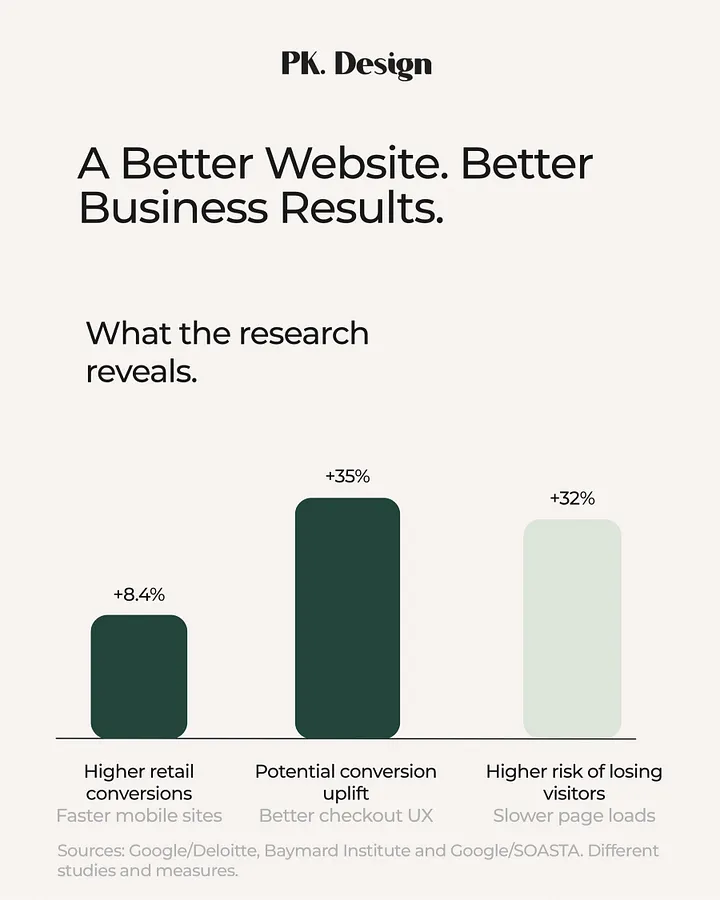
Research finding: 8.4% higher retail conversions
A 2020 study conducted by Deloitte, commissioned by Google, examined the relationship between mobile website speed and business performance across retail, travel, luxury and lead generation websites.
The findings were significant.
An improvement of just 0.1 seconds in mobile website speed was associated with an average 8.4% increase in retail conversions and a 9.2% increase in average order value.
Think about that for a moment.
A fraction of a second can influence whether a visitor continues exploring your website or becomes a paying customer.
For established organisations, the implications extend beyond online retail.
Imagine a prospective client researching accounting firms, healthcare providers, engineering companies or legal services.
They may be comparing several organisations before deciding whom to contact.
If your website loads slowly, is difficult to navigate or creates unnecessary friction, you risk losing their attention before they have an opportunity to understand your expertise.
Your competitors may be only one click away.
The business lesson: Website speed isn’t simply a technical consideration. It can influence customer engagement, conversion rates and ultimately commercial performance.
2. User Experience: The Difference Between Interest and Action
Research finding: Up to 35% potential improvement in e-commerce conversions
Research by the Baymard Institute suggests that the average large e-commerce website could potentially increase its conversion rate by approximately 35% through improvements to checkout design and usability.
This is a research-based estimate of potential improvement, not a guaranteed outcome.
The finding highlights something important: attracting visitors is only part of the equation.
What happens after they arrive matters just as much.
A potential customer might be interested in your services but encounter unnecessary obstacles:
- Confusing navigation
- Unclear information about your services
- Complicated enquiry forms
- Poor mobile usability
- Difficulty finding the next step
Every unnecessary obstacle introduces another opportunity for that visitor to abandon the process.
Although Baymard’s research specifically focuses on e-commerce checkout experiences, the broader principle is relevant to service-based organisations.
Consider a commercial law firm.
A prospective client visits the website seeking assistance with a complex business matter.
If the firm’s expertise is clearly presented, relevant services are easy to find and the enquiry process is straightforward, the visitor has a clear path towards contacting the firm.
But if the website is confusing or outdated, that same potential client may continue searching elsewhere.
The business lesson: Good website design is not simply about appearance. It is about making it easier for the right customers to take meaningful action.
3. Slow Websites Can Lose Potential Clients Before They Engage
Research finding: 32% higher probability of visitors leaving
Google/SOASTA research found that when mobile page loading time increases from one second to three seconds, the probability of a visitor leaving rises by 32%.
That means a slower website creates a greater risk of losing visitors before they meaningfully engage with your business.
For established organisations, this raises an important question:
How many potential clients have visited your website and left without ever making contact?
Unlike a missed telephone call or an unanswered email, these missed opportunities can be difficult to recognise.
You may never know that a prospective client considered your organisation.
You may never know that they struggled to find information or became frustrated with the website experience.
And you may never know whether they eventually contacted a competitor.
This is why monitoring website performance, user behaviour and enquiry conversions matters.
It allows organisations to move beyond assumptions and begin understanding how effectively their digital presence supports business development.
The business lesson: The opportunities your website loses may be the ones your organisation never gets the chance to see.
4. Your Website Should Also Save Your Organisation Time and Money
Website performance is not only about generating enquiries or improving conversions.
For many established organisations, a strategically developed website can also improve operational efficiency.
Consider how much time your team spends answering repetitive questions, collecting customer information, arranging appointments or manually processing enquiries.
Some of these tasks may be streamlined through appropriate website functionality.
For example:
Professional services firms
Structured enquiry forms can collect relevant client information before the initial consultation, reducing unnecessary back-and-forth communication.
Healthcare organisations
Online appointment requests, patient information and clearly presented services can make it easier for patients to access the information they need.
Education and training providers
Course information, registrations, document submissions and automated communications can reduce administrative workloads.
Engineering and construction businesses
Well-structured service pages, project portfolios and qualification information can help prospective clients assess capabilities before contacting the business.
The objective isn’t to replace meaningful human interaction.
It’s to reduce unnecessary administrative friction so your team can spend more time on high-value work.
Even modest improvements in operational efficiency can become meaningful when multiplied across a team and an entire year.
A website should not simply create work for your staff. It should help your staff work more effectively.
5. Does Your Website Reflect the Reputation You’ve Built?
Established organisations often invest years developing their reputation.
They recruit experienced professionals, strengthen client relationships, improve services and expand into new markets.
But their website may not reflect that progress.
Imagine an organisation with 20 years of industry experience, a highly capable team and an impressive portfolio of completed projects.
Now imagine its website featuring outdated information, unclear messaging and a design that no longer reflects its market position.
The disconnect can influence how prospective clients perceive the organisation.
Your website is often one of the first places potential clients go to assess your credibility.
Before speaking with your team, they may use it to understand your expertise, explore your services and determine whether your organisation is suitable for their needs.
A strong digital presence should communicate the same professionalism, capability and credibility that clients experience when dealing with your organisation directly.
Your website should reflect the business you are today, not the business you were five or ten years ago.
6. What Should an Established Organisation Expect From Its Website?
An effective business website should be measured by more than how modern it looks.
It should contribute to defined business objectives.
Depending on the organisation, these might include:
- Better-quality enquiries: Attracting prospective clients who understand your services and are a suitable fit.
- Stronger credibility: Communicating your capabilities, experience and market position.
- Operational efficiency: Reducing repetitive administrative tasks through improved processes and integrations.
- Improved customer experience: Making information easier to find and interactions easier to complete.
- Organic visibility: Helping relevant audiences discover your organisation through search engines.
- Long-term scalability: Providing a digital foundation that can evolve alongside the business.
These outcomes require more than attractive design.
They require thoughtful planning, a clear understanding of business objectives and a website architecture built around the needs of both the organisation and its customers.
That is the difference between simply having a website and having a strategic digital asset.
7. Is Your Website Supporting Growth or Holding It Back?
If your organisation has grown significantly over the past few years, it may be worth reviewing whether your website has kept pace.
Ask yourself:
- Does our website accurately reflect our current capabilities and reputation?
- Can prospective clients easily understand what we offer?
- Are we attracting the right enquiries?
- Is our website performing effectively across mobile devices?
- Could we reduce administrative workloads through better digital processes?
- Are we measuring how our website contributes to business outcomes?
You may not need an entirely new website.
In some cases, targeted improvements to speed, content, navigation or functionality can deliver meaningful benefits.
In others, a more comprehensive digital strategy and website redevelopment may be appropriate.
The right decision depends on your current website, your organisation’s objectives and the opportunities available.
Final Thoughts: Your Website Is a Business Investment
You’ve invested years building your organisation’s reputation. Your website should help protect and strengthen it.
Research demonstrates that website speed and user experience can influence customer behaviour and conversion performance.
But the opportunity extends beyond the numbers.
For established organisations, a strategically developed website can strengthen credibility, create a better customer experience, improve efficiency and support long-term business growth.
The question is no longer simply whether your organisation has a website.
The real question is whether your website is delivering the value your business needs.
Is Your Website Working as Hard as Your Business?
At PK Design, we work with established organisations to create strategic websites that go beyond aesthetics.
We combine thoughtful design, digital strategy and technical expertise to develop websites that reflect your organisation’s reputation, support operational efficiency and create opportunities for sustainable growth.
If your organisation has outgrown its current website, it may be time to rethink what your digital presence could achieve.
Let’s explore how your website can better support your business.
www.pkdesign.com.au
⸻
Research Sources
- Deloitte (2020), Milliseconds Make Millions
- Research commissioned by Google examining how improvements in mobile website speed influence customer engagement and conversion performance.
https://www.deloitte.com/ie/en/services/consulting/research/milliseconds-make-millions.html
2. Baymard Institute, Cart & Checkout Usability Research
Research examining e-commerce checkout usability and the potential improvement in conversions through better design.
https://baymard.com/research/checkout-usability
3. Google/SOASTA (2017), The Need for Mobile Speed
Research examining the relationship between mobile page loading times and visitor bounce probability.
https://www.thinkwithgoogle.com/_qs/documents/2453/64237_mobile-page-speed-new-industry-benchmarks_D2QxHYw.pdf
Research findings are drawn from separate studies and populations. Results should not be interpreted as guaranteed business outcomes for individual organisations.